The Crooked Rider Check: What Your Horse Is Telling You About Your Saddle Position
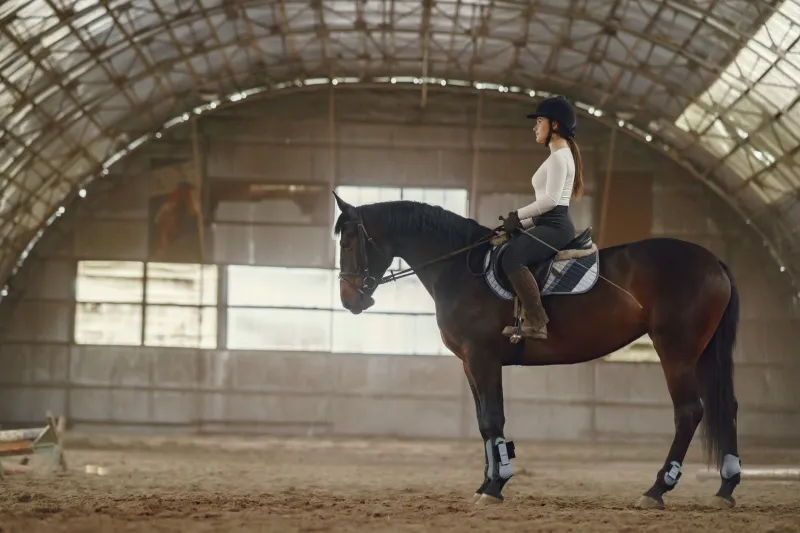
Every yard has one. The horse who drifts left on the centre line, bulges a right shoulder on a circle, and somehow loses the right canter every time you ask for it in a competition. The owner has spent months on suppling exercises, checked teeth, had the physio out, tried three bits and two different saddle pads. Then the coach videos from C and says the sentence nobody wants to hear: ‘It might not be the horse.’
That is not a criticism, and it is not a suggestion that you are riding badly. It is just the reality of being a human on a living, breathing animal. We all have a dominant hand, a stiffer hip, a shoulder that likes to creep forward. On the ground those things are barely noticeable. In the saddle, they are amplified through the horse’s back and ribs every single stride. For a sport horse in full work, that can show up as crookedness, resistance, or a frustrating one-sided performance that never quite goes away.
The horse is not being difficult; they are being consistent
Horses are brilliant at adapting to the rider they have. If your left hip collapses slightly and your right hand is a touch stronger, your horse will find a way to carry you. They will compensate. They will bend a little more easily one way, fall out through one shoulder, or hold tension in the opposite poll. None of that means they are naughty. It means they are consistent.
The problem is that consistency can become a habit. A horse who is always ridden by a rider with a collapsed left hip may become genuinely stronger on the right side, or develop a favourite canter lead that has less to do with natural balance and more to do with the person on top. That is why the usual training fixes can feel like chasing your tail. You supple the horse, but the rider keeps asking the same crooked question.
Three off-horse checks you can do in the tack room
You do not need a biomechanics lab to find your own tendencies. Start with simple awareness checks at home.
First, stand in front of a mirror and march on the spot with your eyes closed for twenty steps. Open your eyes and look at your feet. Is one foot consistently further forward? Is one shoulder lower? Many riders find their ‘natural’ stance is not symmetrical at all.
Second, try a single-leg balance test. Stand on each leg for thirty seconds, preferably barefoot, and notice which side wobbles more or which hip drops. You are not looking for perfection, just information. A hip that cannot stabilise you standing still is unlikely to be quietly stable in rising trot.
Third, use your phone. Ask a friend to video you walking and trotting up in hand from behind and from the side. It sounds odd, but the way you stand and move on the ground often mirrors what happens in the saddle. A dropped shoulder or a hip that hitches can be easier to spot on a small screen than from the saddle.
What your coach, physio and saddle fitter are actually seeing
UK coaches see rider asymmetry all the time, and most will spot it before they spot the horse’s evasion. Common patterns include a collapsed inside hip on circles, a twisted shoulder on the approach to a fence, and a stronger hand on the dominant side that never quite gives. It is rarely dramatic. It is usually small enough that the rider cannot feel it and the horse cannot ignore it.
Physiotherapists working with riders often see the same story from the other direction: a hip that has lost rotation, a thoracic spine that is stiff on one side, or a shoulder that sits forward after years of computer work and driving. A chartered physio with equestrian experience, such as an ACPAT-registered practitioner, can assess whether your asymmetry is a training habit, a mobility issue, or something that needs proper treatment.
Saddle fitters see it too. A saddle that consistently slips to one side, wears unevenly at the flocking, or leaves the rider feeling like they are sitting slightly downhill is worth investigating. It may be the saddle, it may be the horse, or it may be the rider. Often it is a combination. If your saddle is moving, get it checked by a qualified fitter rather than simply tightening the girth and hoping for the best.
Ridden clues that survive a change of rein
On the horse, look for patterns rather than one-off moments. Video yourself from C and from E. Ride a centre line and see whether you drift. Ask for transitions on both reins and notice whether one feels rushed or hollow. Ride leg yield each way and compare which direction feels like hard work. Rein back and see if the horse steps crookedly, or if you feel yourself leaning.
A useful test is to ride a simple figure of eight with a walk break in the middle. If your horse is genuinely stiffer on one side, you will feel it. If your horse is reacting to your position, you may feel the same stiffness appear in both directions, just in different ways. Another clue is your own body: do you always collapse your left hip in left canter? Does your right hand creep forward on the approach to a fence? Does one rein feel ‘easy’ because you are quietly avoiding the conversation?
A realistic plan that will not turn every hack into rehab
You do not need to spend your life doing exercises on a wobble board. The aim is awareness, not perfection. Pick one focus for a month. If your left hip collapses, make that the only thing you actively think about in two schooling sessions a week. Set a timer for ten minutes of off-horse work on the other days: hip flexor stretches, gentle thoracic rotation, single-leg balance, and a bit of walking. Keep it boring and consistent.
In the saddle, use transitions and poles to give yourself feedback. A pole on a circle will tell you quickly if you are drifting. A walk-to-trot transition on a straight line will show you if you are bracing one hand. Ride with a neck strap or a grab strap if you need to check that your hands are independent. Swap your whip to the other hand for part of a session, not because you need it, but because it changes your default settings.
And be sensible. If you have pain, get it looked at. If your saddle is slipping, get it fitted. If your horse is genuinely uneven, have the vet and physio involved. Rider asymmetry is not a substitute diagnosis for every training problem, but it is one of the most common missing pieces in a sport horse’s programme.
The horse is not there to be a mirror, but they often are one anyway. The good news is that small changes in the rider can produce surprisingly big changes in the way a horse goes. You do not have to be symmetrical to be effective. You just have to know which way you lean, and be willing to ask a better question.