The Ground Beneath the Work: What a Winter Arena Is Telling Your Sport Horse
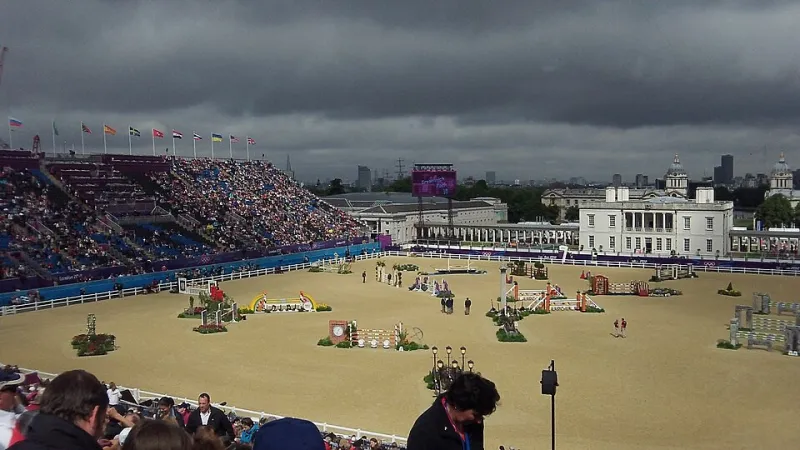
Photo: Martyn Pattison , CC BY-SA 2.0, via Wikimedia Commons
Winter 2026 has a way of making the arena the centre of the sport horse’s world. Fields are holding water, lanes are icy and the competition calendar can feel a long way off. That makes the schooling surface more than a backdrop. It is part of the training load, and it deserves the same attention as feed, shoeing or the warm-up.
The trouble is that arenas rarely fail dramatically. They change. Sand gets deeper at one end, rubber migrates to the kickboards, fibre balls up in the corners and frost turns old footprints into small ridges. A horse can cope with a less-than-perfect surface for a day. Repeat that work for weeks and you have a training problem dressed up as bad weather.
Start With Your Feet, Not Your Aids
Before you tack up, walk the arena. Not the quick march from gate to track, but a proper loop that takes in the track, both long sides, the corners, the centre line and a couple of diagonals. You are looking for contrast. A surface that feels consistent under your boots is doing a lot of quiet work for your horse. A surface that changes every few metres is asking the horse to solve a different problem with every stride.
Push your heel into the sand. If your boot sinks easily, note where and how deep. If you can feel a ridge or a frozen hoofprint through your sole, your horse will feel it through a much smaller hoof. Drag the toe of your boot across the track and see whether the surface crumbles, rolls or holds together. Kickboard edges are worth a look too. Rubber and fibre often migrate away from the working areas and collect at the fence line, leaving the middle shallower or the outside deeper than the yard thinks.
Do this before you ride rather than after. A freshly harrowed arena can look perfect and still be deep in the same old corners. A few photos on your phone, taken from the same spot each week, are surprisingly useful when you are trying to explain that the surface has shifted.
The Five-Minute Surface Walk
Keep the check simple enough that you will actually do it. First, depth: look for footprints that hold water or sit much deeper than their neighbours. Second, consistency: compare the track with the centre, and one corner with the other. Third, edges: check the kickboards and gateways for migrated rubber, banking or a build-up of surface that has been pushed out of the working area. Fourth, drainage: standing water, slush or ice in the same spots each winter is a pattern, not bad luck. Fifth, frost: if the ground has frozen in old hoofprints, the surface is no longer level, even if it looks firm and fast.
You do not need to be a surfaces expert to spot a problem. You need to be consistent. A weekly walk and a note on your phone will tell you more than a one-off inspection after a yard has harrowed.
Questions Worth Asking the Yard Manager
Surface conversations go better when they are practical rather than accusatory. Ask when the arena was last harrowed, levelled or watered, and whether the maintenance schedule changes in freezing weather. Ask what the surface is made of, how old it is and whether it has been topped up recently. If there is a drainage system, ask when it was last checked. If the yard uses a frost plan, ask what it is and how riders will be told when the arena is closed or restricted.
It is also fair to ask about usage. A small arena shared by many horses, especially during winter, will need more maintenance than a surface that only sees a few sessions a day. If the answer is that the surface is due attention but the weather has been against them, that is useful information. You can plan around it. What you cannot plan around is not knowing.
Under Saddle: What the Horse Is Saying
Once you are on, use the warm-up as a surface test. Give the horse a long, quiet walk on a loose rein and watch how he tracks up. Does he step under himself evenly on both reins? Does he shorten on one side of the arena or in one corner? Does he trip, drag a toe or lean into a turn? A horse that feels stuck, choppy or oddly reluctant to stretch down may be telling you that the ground is asking too much.
Be careful not to confuse freshness with discomfort. A sharp horse in a cold wind can feel tense on any surface. The clue is repetition. If the same uneven stride appears in the same part of the arena, or if the horse relaxes as soon as you move to a better patch, the surface deserves a second look. Transitions are useful here. Walk to trot, trot to canter and back again will show you whether the horse can push off evenly or whether he is protecting himself.
Adapting the Plan When the Ground Is Less Than Perfect
If the surface is deep, shorten the session and keep the work conservative. Long canters through deep sand are a fitness test for the horse and a workout for the legs that you may not have planned. If the arena is rutted or frozen, avoid fast work and tight circles. Straight lines, walk work and gentle transitions are kinder than lateral work on an uneven surface. If rubber has migrated to the kickboards, stay off the fence line and ask for the arena to be levelled before you drill circles around the edge.
Sometimes the best adjustment is a change of scene. A safe hack, a walk in hand or ground poles on a good surface can keep the horse moving without fighting the arena. The goal is not to abandon schooling for the winter. It is to stop pretending that every surface is the same.
When to Stop and Ask for Help
If your horse comes out of the arena with heat, filling or swelling in a leg, or if the way he moves changes and stays changed, treat it as a welfare question rather than a training one. Call your vet or physio as appropriate. A surface problem can be part of the picture, but it is not a diagnosis.
Winter 2026 will ask a lot of UK sport horses and their riders. The arena is one of the few places where work can continue when the weather closes in. Checking the ground underfoot is not fussing. It is part of reading the horse, and it is one of the cheapest bits of training advice you will get all season.